UPDATE UPDATE UPDATE AURORA POSSIBLE TONIGHT JAN 19-20
Hey, Space Placers!

Yesterday's eruption on the Sun
Spaceweather.com
UPDATE
G4 (SEVERE) GEOMAGNETIC STORM IS HERE. START TO LOOK FOR THE AURORA AS SOON AS IT GETS DARK.https://www.swpc.noaa.gov/news/g4-severe-geomagnetic-storm-levels-reached-19-jan-2026
Today is Martin Luther King Day https://wtop.com/dc/2026/01/ways-to-honor-dr-martin-luther-king-jr-across-dc-on-monday/ and I hope everyone enjoyed the holiday.
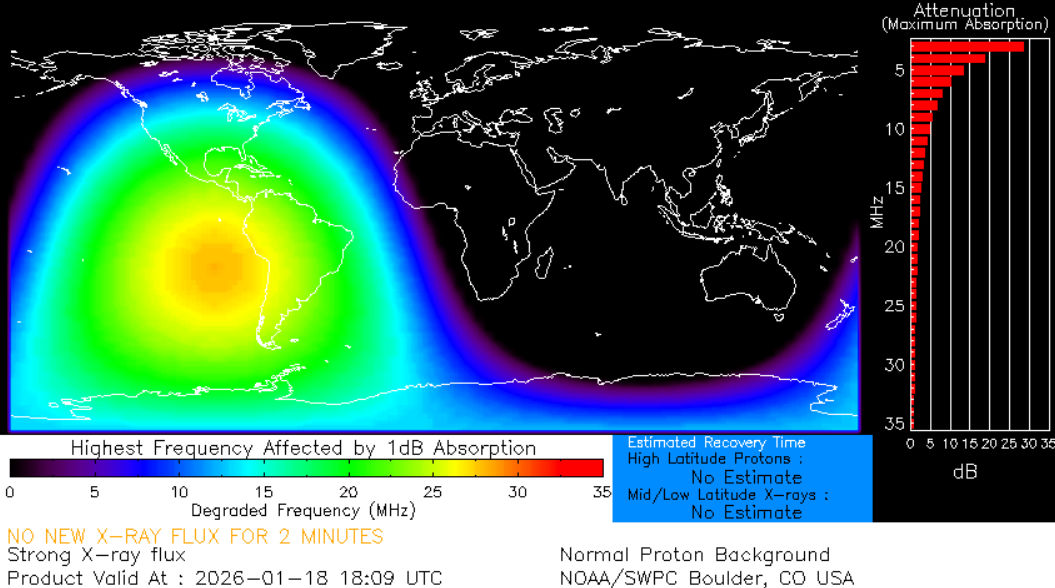
During my twelve-hour drive returning from Florida to see the rollout of Artemis II https://wtop.com/the-space-place/2026/01/artemis-ii-is-on-the-move/ a strong solar flare erupted on the Sun https://www.swpc.noaa.gov/news/x-class-flare-activity-observed-18-january-2026 that gives us the possibility of seeing our first Aurora sightings of 2026. The DMVlast saw the Aurora in November 2025 https://wtop.com/the-space-place/2025/11/northern-lights-sightings-possible-next-few-nights-in-dc-region/ .
The National Oceanic and Atmospheric Administration (NOAA) Space Weather Prediction Center (SWPC) https://www.swpc.noaa.gov/ issued this statement https://www.swpc.noaa.gov/news/g4-severe-geomagnetic-storm-watch-20-january-utc-day this morning:
“A G4 (Severe) geomagnetic storm http://www.swpc.noaa.gov/noaa-scales-explanation watch is in effect for the 20 January UTC-day due to Earth-arrival of a coronal mass ejection (CME) https://www.swpc.noaa.gov/phenomena/coronal-mass-ejections . The CME blasted from the Sun on 18 Jan, in association with an energetic R3 (Strong) solar flare from a sunspot region near center-disk, and is anticipated to arrive at Earth as early as late 19 Jan EST to early 20 Jan. While the G4 Watch is out for the 20 Jan UTC-day, geomagnetic storm levels could range from G1-G3 (Minor-Moderate) upon CME arrival later on 19 Jan EST. CME passage is expected to continue through 20 Jan, but conditions are likely to weaken later in the day. G1 levels remain possible on 21 Jan due to residual CME related effects. Forecasters have a fair measure of confidence in timing and of CME arrival at Earth. Please continue to visit our SWPC webpage for the latest forecasts, information, and updates.”
SWPC has provided the potential impacts of this geomagnetic storm:
Potential Impacts: Area of impact primarily poleward of 45 degrees Geomagnetic Latitude.
Induced Currents - Possible widespread voltage control problems and some protective systems may mistakenly trip out key assets from the power grid. Induced pipeline currents intensify.
Spacecraft - Systems may experience surface charging; increased drag on low earth orbit satellites, and tracking and orientation problems may occur.
Navigation - Satellite navigation (GPS) degraded or inoperable for hours.
Radio - HF (high frequency) radio propagation sporadic or blacked out.
Aurora - Aurora may be seen as low as Alabama and northern California.
SWPC predicted possible radio blackouts https://www.swpc.noaa.gov/news/x-class-flare-activity-observed-18-january-2026 . Spaceweather.com reported https://www.spaceweather.com/archive.php?view=1&day=19&month=01&year=2026 “Radiation from the flare ionized Earth's atmosphere over the Americas, especially South America. This caused a shortwave radio blackout that may have lasted more than an hour at frequencies below 10 MHz.” Also, “Shortwave radios inside the Arctic Circle aren't working right now due to this storm, which is causing a polar cap absorption event."
These Geomagnetic Storms and associated Aurora events forecasted are not predicted to reach the historic levels of May 10th of 2024 https://wtop.com/the-space-place/2024/05/a-severe-geomagnetic-storm-may-be-coming-what-does-that-mean/ . But, we should be watching the skies just in case the Aurora appear.
For the DMV, SWPC’s CURRENT two-day Aurora forecast https://www.swpc.noaa.gov/communities/aurora-dashboard-experimental (subtract 5 hours from UT to get EST) and our forecasted skies https://www.cleardarksky.com/c/WashingtonDCkey.html?1 means there is a good chance we MAY detect Aurora to the North.
If the SWPC forecast holds - readers need to keep checking the website for updates - Aurora conditions for the DMV may be strong enough tonight at 10 p.m. into the early morning hours of January 20, especially 1 a.m. to 7 a.m. to allow us to detect Aurora visually and with our cameras. The predicted G4 level makes Aurora a real possibility.
It will be well worth taking a look to the North tonight after dark until dawn from a dark sky site with a clear horizon. You might be able to visually detect some color in the sky if bright Aurora are present but they will likely be low on the Northern horizon.
Your camera and/or smartphone significantly improve your chances of detecting and imaging the Aurora due to their digital sensors. Even if you do not see Aurora, photograph the Northern horizon to possibly get an image of them.
Use a camera or smartphone that can take exposures of several seconds - including using “Night Sky” or “Low Light” settings if your camera has them - of the Northern horizon. Steady the camera or use a tripod for best image results. The camera can capture Aurora that your eyes did not https://www.space.com/how-to-photograph-the-aurora .
Our best bet is to monitor Clear Sky Chart (input your location) https://www.cleardarksky.com/csk/ for sky conditions, NOAA https://www.swpc.noaa.gov/ and space related social media sites spaceweatherlive.com , EarthSky.org , space.com for Aurora viewing updates. There also are Aurora apps available as well to help you; I use Aurora Pro and Glendale App.
Good luck, Aurora chasers…….
Sky Guy in VA


Comments
Post a Comment