Hubble Solves Merger Mystery From Milky Way’s Early Years

Hey, Space Placers!
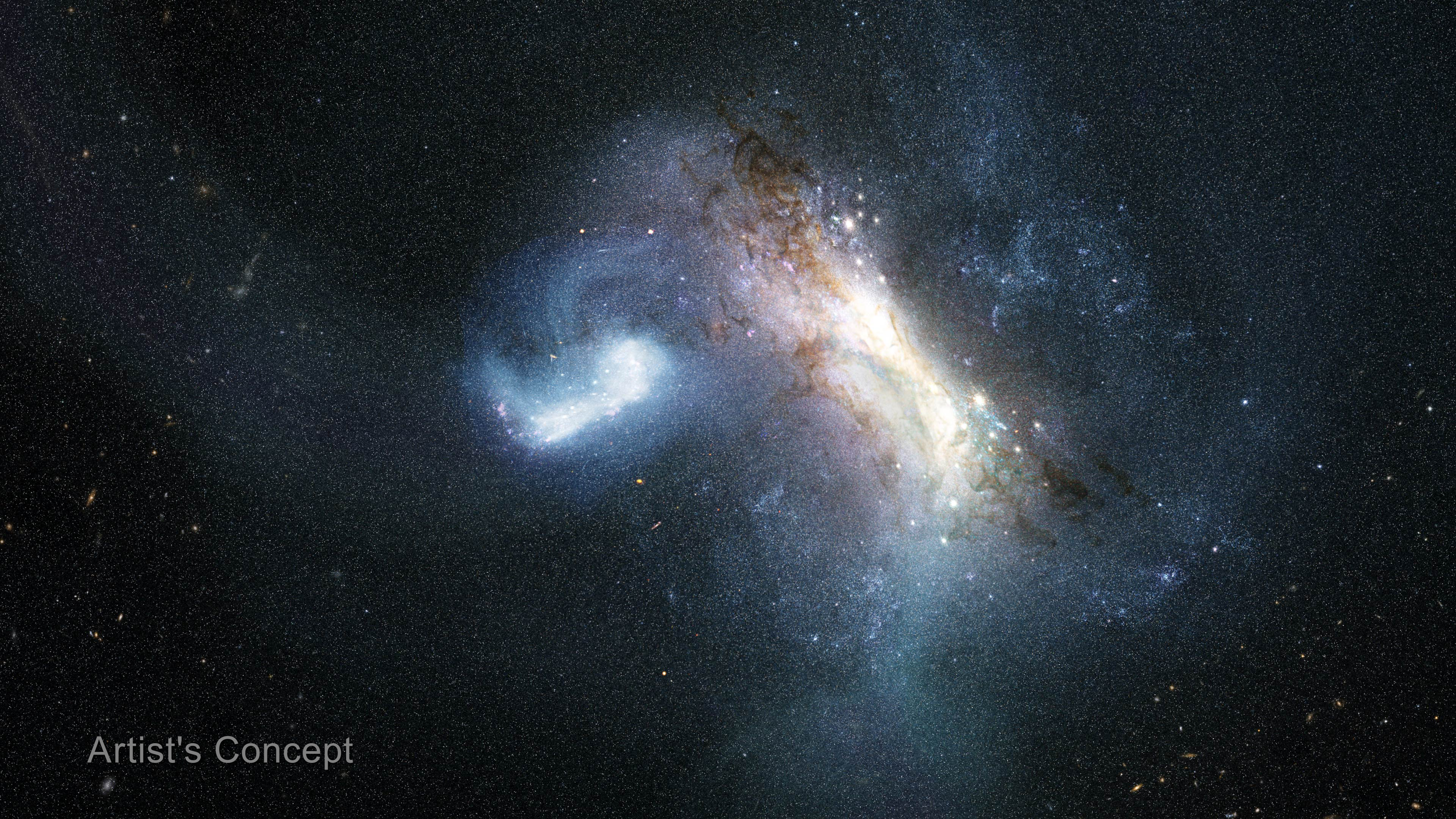
An illustration of two galaxies in the midst of a collision against a dark, star-filled background.  The collision takes up the middle third of the illustration. On the right, a larger galaxy is viewed at an angle from 11 o’clock to 4 o’clock, with a white-yellow core surrounded by mottled brown dust lanes and faint bluish spiral arms. To the left, a smaller, bright blue-white galaxy is stretched into a curved, hook-like shape as gravity distorts it. A broad, glowing bridge of pale blue gas and stars extends off the galaxy at the left, while wispy streams extend above and below the larger galaxy at the right. The words “Artist’s Concept” appear in the lower left corner.

About 12 billion years ago, a dwarf galaxy known as LKH collided with a young Milky Way and merged with it. This artist’s concept portrays that collision. NASA’s Hubble Space Telescope uncovered definitive evidence of this collision by studying globular star clusters.
Illustration: NASA, ESA, Joseph Olmsted (STScI)

Sky Guy in vA

Comments

Popular posts from this blog

Humanity Is Becoming Part of the Geological Record

NORTHERN LIGHTS MAY BE VISIBLE TONIGHT

Why “city-killer” asteroid YR4’s impact probability keeps increasing